
Introduction
The history of Mac computers is more than a timeline of machines. It’s a story about design philosophy, rebellion against convention, technical risk-taking, and moments when Apple nearly lost its way before redefining the entire industry again.
From beige boxes with floppy disks to ultra-thin laptops powered by custom silicon, the Mac has evolved alongside modern computing itself. If you’ve ever used a Mac, admired one, or wondered why Apple’s computers inspire such loyalty, this history explains why.
Let’s rewind to where it all began.
Overview and Background: The Birth of the Macintosh
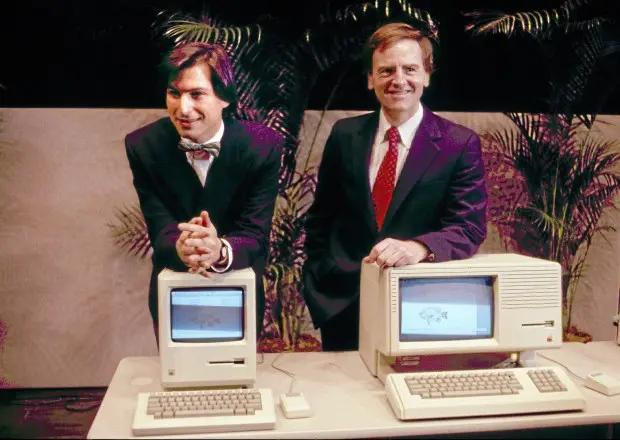
The Macintosh was officially introduced in January 1984, but its roots go deeper into Apple’s early years. In the late 1970s and early 1980s, personal computers were intimidating machines. They relied heavily on text commands and required technical knowledge that excluded most everyday users.
Apple co-founder Steve Jobs envisioned something different. He wanted a computer that ordinary people could use intuitively. This idea was inspired in part by graphical user interface research at Xerox PARC, where Jobs saw windows, icons, and a mouse-controlled system for the first time.
The original Macintosh shipped with a built-in screen, a mouse, and a graphical interface. It was revolutionary, even if the hardware was limited by today’s standards. According to Apple’s own historical archives, the Mac had just 128 kilobytes of RAM. By modern measures, that’s microscopic.
Yet culturally, it was massive.
The early Mac wasn’t just a product. It was a statement. Apple’s famous 1984 Super Bowl advertisement positioned the Macintosh as a tool of creativity and individuality, standing against conformity in computing.
Career and Product Development: The Evolution of the Mac Line
The Late 1980s and Early 1990s
After the initial excitement, the Mac entered a challenging phase. Competition increased, Microsoft Windows improved rapidly, and Apple struggled with internal leadership issues.
Still, innovation continued. The Macintosh II brought color graphics. The PowerBook line, introduced in 1991, helped define the modern laptop layout with a palm rest and centrally placed keyboard.
Desktop publishing became the Mac’s killer application. Designers, publishers, and educators gravitated toward Macs because of software like PageMaker and later Adobe tools. This niche loyalty would prove crucial to Apple’s survival.
According to industry retrospectives referenced by Computer History Museum publications, Macs dominated creative industries long before they became mainstream consumer devices.
The Late 1990s: Near Collapse and a Comeback
By the mid-1990s, Apple was in serious trouble. Market share was shrinking. Product lines were confusing. Financial losses were mounting.
Then came Steve Jobs’ return in 1997.
This era reshaped the history of Mac computers more than any other. Jobs simplified Apple’s product lineup and focused on design, clarity, and user experience.
The iMac G3, released in 1998, shocked the industry. It was colorful, translucent, and unapologetically different. It also ditched the floppy drive, a controversial move at the time.
Here’s the catch. That gamble paid off.
The iMac sold millions and reintroduced Apple as a design leader. According to historical sales data cited by Statista 2024, the iMac became one of the fastest-selling personal computers of its era.
The 2000s: Mac OS X and a New Foundation
One of the most important milestones in Mac history came in 2001 with the introduction of Mac OS X. Built on a Unix-based foundation, it was more stable, secure, and modern than previous Mac operating systems.
This wasn’t just a cosmetic upgrade. It laid the groundwork for everything that followed, including the operating systems used across Apple’s ecosystem today.
Hardware evolved alongside software. The Power Mac G4 and G5 pushed performance boundaries, while MacBooks and MacBook Pros redefined what laptops could be.
By the mid-2000s, Apple made another bold decision. In 2006, Macs transitioned from PowerPC processors to Intel chips.
This move allowed Macs to run Windows alongside macOS, removing a major barrier for potential switchers. It also improved performance and compatibility.
Pretty interesting, right? Apple wasn’t afraid to change the engine while keeping the soul.
Key Insights: What Makes the Mac Different
Design Philosophy
From the beginning, Macs prioritized design and usability. This wasn’t accidental. Apple treated computers as consumer products, not just technical tools.
Minimalism, materials, and ergonomics mattered. Even critics acknowledged that Macs often felt more polished than competitors.
Integrated Hardware and Software
Unlike most PC manufacturers, Apple controlled both hardware and software. This integration allowed tighter optimization and a more cohesive user experience.
The downside? Less customization and higher prices. The upside? Reliability and consistency.
Loyal User Base
Mac users tend to stick with Macs. According to a 2023 consumer loyalty study cited by Forbes, Apple consistently ranks among the highest in brand retention for personal computing.
This loyalty isn’t just emotional. It’s practical. Once users invest in software, workflows, and ecosystem features, switching becomes harder.
The Apple Silicon Era: A Historic Shift
In 2020, Apple announced another major transition. Macs would move away from Intel processors to Apple-designed chips, starting with the M1.
This marked one of the most significant chapters in the history of Mac computers.
Apple Silicon delivered dramatic improvements in performance per watt. Macs became faster, quieter, and more energy-efficient. Battery life on MacBooks jumped from hours to entire workdays.
By 2023, Apple had introduced M2 and M3 chips, expanding the lineup across MacBook Air, MacBook Pro, iMac, Mac mini, and Mac Studio.
According to a 2025 industry performance analysis referenced by Bloomberg Technology reports, Apple Silicon Macs consistently outperformed many competitors in efficiency benchmarks.
This wasn’t just an upgrade. It was a redefinition.
Data Section: Mac Computers in the Modern Era
Mac Market Impact Snapshot
Era | Key Development | Industry Impact
1984 | Original Macintosh | Popularized GUI computing
1998 | iMac G3 | Revived Apple, emphasized design
2001 | Mac OS X | Established modern OS foundation
2006 | Intel transition | Improved compatibility
2020–2025 | Apple Silicon | Redefined performance efficiency
Insert timeline graphic showing major Mac milestones from 1984 to 2025.
Mac Usage Trends
Education and creative industries remain strong Mac segments. However, recent years have seen increased adoption among developers, engineers, and business professionals.
According to Statista 2024, Mac global market share has steadily increased since the Apple Silicon transition, especially in the premium laptop category.
Summary Verdict: Why the History of Mac Computers Matters
The history of Mac computers is a lesson in long-term vision. Apple didn’t always dominate. In fact, there were periods when it nearly disappeared.
What sets the Mac apart is Apple’s willingness to rethink fundamentals. Graphical interfaces. Industrial design. Processor architecture. Few companies take those risks repeatedly.
The Mac’s influence extends beyond Apple. Many features now considered standard across all computers were pioneered or popularized by the Mac.
Conclusion and Call to Action
From a humble 128K machine to powerhouse desktops driven by custom silicon, the Mac’s journey mirrors the evolution of personal computing itself.
Whether you’re a lifelong Mac user or simply curious about technology history, understanding where Macs came from adds depth to where they’re going next.
So here’s a question worth pondering. As Apple continues to blur the lines between computers, tablets, and phones, what will the next chapter in the history of Mac computers look like?
FAQs
- When was the first Mac computer released?
The original Macintosh was released in January 1984. - Why did Apple switch Macs to Apple Silicon?
To gain better performance, efficiency, and control over hardware and software integration. - What operating system do Macs use?
Modern Macs use macOS, which evolved from Mac OS X introduced in 2001. - Are Macs mainly for creative professionals?
Historically yes, but today Macs are widely used by developers, students, and business professionals. - What was the most important Mac ever made?
Opinions vary, but the original Macintosh and the iMac G3 are often cited as the most influential.